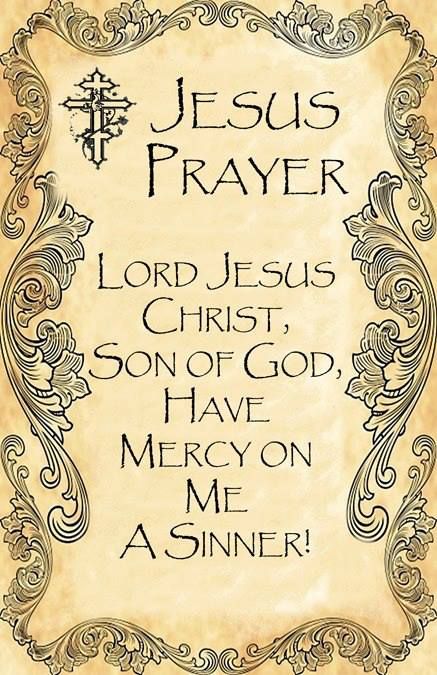
Showing posts with label Jesus Prayer. Show all posts

Saturday, May 29, 2021

The Jesus Prayer and Six Promises of God: The Sixth Promise

Parts I, II, III, IV, and V can be found here, here, here, here, and here, respectively.

The full form of the Jesus Prayer, “Lord Jesus Christ, Son of God, have mercy on me, a sinner,” incorporates at least six biblical promises. These are:

1. Romans 10:9 — If you confess with your mouth the Lord Jesus and believe in your heart that God has raised Him from the dead, you will be saved. (cf. John 6:40; Romans 10:10-13)


2. 1 Corinthians 12:3 — No one can say “Jesus is Lord” except in the Holy Spirit. (cf. John 15:26)


3. 1 John 5:1 — Everyone who believes that Jesus is the Christ has been born of God, and everyone who loves the Father loves whoever has been born of him. (cf. Matthew 16:16-17)


4. 1 John 4:15 — Whoever confesses that Jesus is the Son of God, God abides in him, and he in God. (cf. Romans 8:16-17; 1 John 2:23, 5:10)


5. John 14:14 — If you ask me anything in my name, I will do it. (cf. John 14:13, 15:16, 16:23-24) 


6. 1 John 1:9 — If we confess our sins, he is faithful and just to forgive us our sins and to cleanse us from all unrighteousness. (cf. Luke 18:14)


On the Sixth Promise


By confessing our sins to God, we not only offer them up in humility to be forgiven in Christ, but also offer our very souls to be cleansed. This is a twofold reality, and is grounded in the verse in 1 John preceding, which states, “If we walk in the light, as he is in the light, we have fellowship one with another, and the blood of Jesus Christ his Son cleanseth us from all sin” (1 John 1:7). In other words, the shed blood of Christ cleanses us from both the guilt and the stain of sin. Sin, which is an action, is also and more fundamentally like a progressive disease which inheres to and corrupts our souls unto death. In other words, sin is a spiritual sickness which produces sinful action. Just like how an infectious disease produces fever, so the infection of sin produces sinful action. Thus not only the symptom of sin's fever must be treated, but also the fundamental corruption of the disease of sin must be healed. And so the blood of Christ effects a double action: one which deals with the symptom, which is to say the fever of sin; and another which deals with the more fundamental cleansing, which is to say the underlying disease of sin. Both aspects are found through the sacrifice of Christ on the Cross. The spilling of His righteous blood, which we receive in childlike faith as being given on our behalf, acts so as to objectively forgive the sin which we have committed. Not stopping there, it also works to restore us to cleanse us of all unrighteousness. This cleansing is the restoration of fellowship with God in Christ. What a mighty promise! And this is why confession is such a vital subject, and can never be treated flippantly as if it were optional, as if it were some superficial listing of mistakes, or as if it were simply a matter of regret for wrongs done. Confession must go all the way to the heart of the problem, the rupture of fellowship with God due to our hardened hearts and our stiff necks. Sin is such a corruption that God decided that the death of Christ on the Cross was the best way to deal with it. And so the forgiveness of sin and the cleansing of all unrighteousness came together at a great cost, and yet it is freely extended to all. Thus through confession not only does He promise to forgive and cleanse, but also to reestablish communion with Him as you walk in the Light that is Christ.


The Jesus Prayer and Six Promises of God: The Fifth Promise


Parts I, II, III, and IV can be found here, here, here, and here, respectively.

The full form of the Jesus Prayer, “Lord Jesus Christ, Son of God, have mercy on me, a sinner,” incorporates at least six biblical promises. These are:


1. Romans 10:9 — If you confess with your mouth the Lord Jesus and believe in your heart that God has raised Him from the dead, you will be saved. (cf. John 6:40; Romans 10:10-13)


2. 1 Corinthians 12:3 — No one can say “Jesus is Lord” except in the Holy Spirit. (cf. John 15:26)


3. 1 John 5:1 — Everyone who believes that Jesus is the Christ has been born of God, and everyone who loves the Father loves whoever has been born of him. (cf. Matthew 16:16-17)


4. 1 John 4:15 — Whoever confesses that Jesus is the Son of God, God abides in him, and he in God. (cf. Romans 8:16-17; 1 John 2:23, 5:10)


5. John 14:14 — If you ask me anything in my name, I will do it. (cf. John 14:13, 15:16, 16:23-24) 


6. 1 John 1:9 — If we confess our sins, he is faithful and just to forgive us our sins and to cleanse us from all unrighteousness. (cf. Luke 18:14)


On the Fifth Promise


At its core, asking something in Jesus’ holy Name means being in harmony with His will, which is also to say His greater wisdom, authority, and power. It is founded upon the divine promise given by Christ. This, being a promise, means that it can be relied upon to be upheld by His unwavering faithfulness. This excludes the idea that it is the reduction of Christ to being a genie. The word genie comes from an old Arabic word, jinn, referring to a kind of supernatural being, a term which came into English usage through translations of the Arabian Nights where a jinn was being manipulated to grant selfish wishes. God is not anything like a jinn, for He is the Almighty Creator of all, the thrice Holy One who maintains all things by the Word of His power (Hebrews 1:3). Moreover, as one who Covenants with His People, God does not promise to accomplish anything in His Name that is not also consistent with His holy nature and righteous character. We have to recall that the promise of Christ to do anything asked in His Name extends to those who are in and with Him. This occurs inexorably through the sacrament of holy Baptism, which is first and foremost a dying to self, a putting off of all worldly ways. Many people mistakenly think they can be a Christian and yet also at the same time a self-willed manmukh. An old Punjabi word, a manmukh is a person who follows their own mind and desires, without regard to God’s truth. This kind of person prizes their own thoughts, or the collective thoughts of their family or tribe, placing them above the revealed thoughts of God as given in His holy Word, the Bible, and as consistently maintained in the Church. This kind of person, when they encounter God’s promise to do something for His children when they pray in His Name, start to approach God as if He were simply there to guarantee that their selfish or tribal will is accomplished. When God resists their pride they end up blaming God for not obeying them, and so enter into all sorts of blasphemy. This precious promise of God is thus wholly for those who approach Him in faith as His obedient child. For in approaching God in Christ, it is not enough to simply be a socially “good” person, one must be His the Father's holy child by adoption into Christ Jesus His Son. But, if one approaches in humble faith, seeking God’s will and glory, then they can with all confidence ask in His Name, and He will do it. It may not be answered in an expected way, an obvious way, or an easy way, but it will be answered. For the most fundamental desire of a child of God is to be holy as He is holy, to seek to do His will in all things, and doing all for His glory.


Friday, May 21, 2021

The Jesus Prayer and Six Promises of God: The Fourth Promise

Parts I, II, and III can be found here, here, and here, respectively.

The full form of the Jesus Prayer, “Lord Jesus Christ, Son of God, have mercy on me, a sinner,” incorporates at least six biblical promises. These are:


1. Romans 10:9 — If you confess with your mouth the Lord Jesus and believe in your heart that God has raised Him from the dead, you will be saved. (cf. John 6:40; Romans 10:10-13)


2. 1 Corinthians 12:3 — No one can say “Jesus is Lord” except in the Holy Spirit. (cf. John 15:26)


3. 1 John 5:1 — Everyone who believes that Jesus is the Christ has been born of God, and everyone who loves the Father loves whoever has been born of him. (cf. Matthew 16:16-17)


4. 1 John 4:15 — Whoever confesses that Jesus is the Son of God, God abides in him, and he in God. (cf. Romans 8:16-17; 1 John 2:23, 5:10)


5. John 14:14 — If you ask me anything in my name, I will do it. (cf. John 14:13, 15:16, 16:23-24) 


6. 1 John 1:9 — If we confess our sins, he is faithful and just to forgive us our sins and to cleanse us from all unrighteousness. (cf. Luke 18:14)


On the Fourth Promise

He who confesses from the heart that Jesus is the Son of God has God abiding in him. In other words, God abiding in a man makes this confession possible. True confession is the result of God’s holy operation in the soul. And the opposite is also true: “Who is a liar but he that denieth that Jesus is the Christ? He is antichrist, that denieth the Father and the Son. Whosoever denieth the Son, the same hath not the Father” (1 John 2:22-23). In other words, those who do not confess Jesus as the Son do not have God as their Father, and in fact are opposed to the truth. And for a confession to be an authentic confession, it is not simply a matter of moving the lips, but having the heart moved by the Gospel. The heart moved by the Gospel is the heart moved by the power of God, for "the Gospel is the power of God unto salvation to everyone that believeth" (Romans 1:16). In this way the Gospel is the way of being in right relationship with divine reality. The Gospel is therefore not merely a religious message, and Christianity is not merely one way among others. There aren’t multiple true religions. One is either with Christ and God, or against Christ and God. For the whole world labors under the condemnation of sin, willingly bound to hell. But into this great spiritual slavery to evil God the Father sent His Only-Begotten Son. Christ is in this way the mercy of God extended. He is not merely a wise teacher, nor merely a miracle worker, nor merely an enlightened being. He is Himself Salvation, and He entered into the world in order to deliver those who believe in His Name. That is why Scripture says, “Neither is there salvation in any other: for there is none other name under heaven given among men, whereby we must be saved” (Acts 4:12). And so it is not simply that Christianity is a better system of ideas. It is the reality of God’s Personal in-breaking into the world to save man from a very real bondage to sin unto death and from a very real bondage to a very real Satan. Thus it cannot be said that there is no salvation in any other name as if God loves only Christians. That view of religion fails to touch the depth of the reality of the Incarnation. Christ is Himself the love of God, who is God, who came into the world to save sinners via their incorporation into Him through confessed faith, for that confession is a participation, an abiding, in Him. This promise is therefore most wonderful, for “this is the promise that he hath promised us, even eternal life” (1 John 2:25).

Saturday, May 8, 2021

The Jesus Prayer and Six Promises of God: The Third Promise

Parts I and II can be found here and here, respectively.

The full form of the Jesus Prayer, “Lord Jesus Christ, Son of God, have mercy on me, a sinner,” incorporates at least six biblical promises. These are:


1. Romans 10:9 — If you confess with your mouth the Lord Jesus and believe in your heart that God has raised Him from the dead, you will be saved. (cf. John 6:40; Romans 10:10-13)


2. 1 Corinthians 12:3 — No one can say “Jesus is Lord” except in the Holy Spirit. (cf. John 15:26)


3. 1 John 5:1 — Everyone who believes that Jesus is the Christ has been born of God, and everyone who loves the Father loves whoever has been born of him. (cf. Matthew 16:16-17)


4. 1 John 4:15 — Whoever confesses that Jesus is the Son of God, God abides in him, and he in God. (cf. Romans 8:16017; 1 John 2:23, 5:10)


5. 1 John 1:9 — If we confess our sins, he is faithful and just to forgive us our sins and to cleanse us from all unrighteousness. (cf. Luke 18:14)


6. John 14:14 — If you ask me anything in my name, I will do it. (cf. John 14:13, 15:16, 16:23-24)


On the Third Promise


Belief in Jesus as the Christ requires a supernatural act of God vivifying the soul to this truth. It is the necessary second birth, without which we cannot see the Kingdom of God. As Jesus teaches: “Do not marvel that I said to you, ‘You must be born again’” (John 3:7). For, “Truly, truly, I say to you, unless one is born again he cannot see the kingdom of God” (John 3:3). This rebirth is so important, but what does it entail? It entails the recognition of Jesus as your life. Not that He is merely important to your life, a central part of your life, or even that He is the purpose of your life, but that He Himself is your life. As He declares: “I am the resurrection and the life. He who believes in Me, though he may die, he shall live” (John 11:25). Notice three elements in that verse: (1) Jesus is the life, (2) those who believe in Him, (3) will live. In other words, since belief receives Jesus, and Jesus is the life, to receive Jesus is to receive the life. He is and becomes in experience the substance of the Christian’s life. One is thus born again, regenerated by the life that is Jesus Christ; one is born of God, what He also declares is being “born of the Spirit” (John 3:8). This is the context and substance of that most famous of bible verses: “For God so loved the world that He gave His only begotten Son, that whoever believes in Him should not perish but have everlasting life” (John 3:16). That is why St. John the Forerunner can say: “He who believes in the Son has eternal life; and he who does not believe the Son shall not see life, but the wrath of God remains on him” (John 3:36). Notice how wrath is said to remain or abide on those who do not believe. It is thus not that God punishes those who do not believe in Christ by depriving them of life; it is that (1) Christ Himself is eternal life, (2) believing in Him is receiving He who is Himself eternal life, (3) not believing in Christ means not having Him, which means (4) those do not believe do not have eternal life. What is rather the case is that divine wrath remains on those who do not believe. Christ is the instrument of deliverance from wrath, as St. Paul teaches: “Since, therefore, we have now been justified by his blood, much more shall we be saved by him from the wrath of God” (Romans 5:9), “Jesus who delivers us from the wrath to come” (1 Thessalonians 1:10). This is why the promise is so especially precious and incomparable, for it is the divine promise of the eternal life we hope for from the bottom of our hearts. This life is Jesus Himself, and is received by faith in such a way that one is a new creation, for “if anyone is in Christ, he is a new creation. The old has passed away; behold, the new has come” (2 Corinthians 5:17).

Friday, April 23, 2021

The Jesus Prayer and Six Promises of God: The Second Promise

(The present article follows upon the previous, which speaks to the first promise listed below.)


The full form of the Jesus Prayer, “Lord Jesus Christ, Son of God, have mercy on me, a sinner,” incorporates at least six biblical promises. These are:


1. Romans 10:9 — If you confess with your mouth the Lord Jesus and believe in your heart that God has raised Him from the dead, you will be saved. (cf. John 6:40; Romans 10:10-13)


2. 1 Corinthians 12:3 — No one can say “Jesus is Lord” except in the Holy Spirit. (cf. John 15:26)


3. 1 John 5:1 — Everyone who believes that Jesus is the Christ has been born of God, and everyone who loves the Father loves whoever has been born of him. (cf. Matthew 16:16-17)


4. 1 John 4:15 — Whoever confesses that Jesus is the Son of God, God abides in him, and he in God. (cf. Romans 8:16017; 1 John 2:23, 5:10)


5. John 14:14 — If you ask me anything in my name, I will do it. (cf. John 14:13, 15:16, 16:23-24)


6. 1 John 1:9 — If we confess our sins, he is faithful and just to forgive us our sins and to cleanse us from all unrighteousness. (cf. Luke 18:14)


On the Second Promise

To truly say that Jesus is Lord is to enliven to and recognize the reality of His Lordship. This recognition is a state of soul awakened by the Holy Spirit through the implanted word via the preaching of the Gospel, as St. Peter teaches, "since you have been born again, not of perishable seed but of imperishable, through the living and abiding word of God... And this word is the good news that was preached to you" (1 Peter 1:23, 25). For if one is outside of the Holy Spirit they cannot recognize Christ’s Lordship, because it is precisely the action of the Holy Spirit to awaken the soul to Christ, as Christ Himself teaches: “When the Helper comes, whom I will send to you from the Father, the Spirit of truth, who proceeds from the Father, he will bear witness about me” (John 15:26). In other words, when a person submissively recognizes the Lordship of Christ, it means that the Holy Spirit is present and active. This is of the essence of salvation, and is why St. Paul can speak so boldly when he declares: “You, however, are not in the flesh but in the Spirit, if in fact the Spirit of God dwells in you. Anyone who does not have the Spirit of Christ does not belong to him” (Romans 8:9). What this means is that for you to recognize the Lordship of Jesus Christ is for you also to be in the Holy Spirit, and likewise to be in the Holy Spirit is to have the Holy Spirit in you, and to thus have the Holy Spirit is to belong to Christ. This mutual indwelling hearkens to Jesus’ astounding high priestly prayer, “that they may all be one, just as you, Father, are in me, and I in you, that they also may be in us, so that the world may believe that you have sent me. The glory that you have given me I have given to them, that they may be one even as we are one, I in them and you in me, that they may become perfectly one, so that the world may know that you sent me and loved them even as you loved me” (John 17:21-23). Notice how Christ speaks of the Father being in Him, and how He is in the Father. This points to the fundamental holy unity of Father and Son, of God and Word, and yet points further to the nature of our union with God in Christ, for Christ prays that we will be in the Father and in Him, and He in us and therefore the Father in us. This is the breadth and length and height and depth of our salvation! For we are not merely delivered from sin, even though that is a truly awesome deliverance. And we are not merely written into the Book of Life, although that is truly an awesome inscription. We are, rather, made to have complete union with God the Father, God the Son, and God the Holy Spirit, to share in the eternal bond of their light, their life, and their love. This is the reality pointed to and participated in through our praying of the Jesus Prayer. Therefore, when you call upon Jesus as Lord, submitting to His Lordship, trust in God’s promise and know that through the strength of God’s promise that the Holy Spirit is in you, and you are in Him.

-Fr. Joshua Schooping

Saturday, April 17, 2021

The Jesus Prayer and Six Promises of God: The First Promise

The full form of the Jesus Prayer, “Lord Jesus Christ, Son of God, have mercy on me, a sinner,” incorporates at least six biblical promises. These are:


1. Romans 10:9 — If you confess with your mouth the Lord Jesus and believe in your heart that God has raised Him from the dead, you will be saved. (cf. John 6:40; Romans 10:10-13)


2. 1 Corinthians 12:3 — No one can say “Jesus is Lord” except in the Holy Spirit. (cf. John 15:26)


3. 1 John 5:1 — Everyone who believes that Jesus is the Christ has been born of God, and everyone who loves the Father loves whoever has been born of him. (cf. Matthew 16:16-17)


4. 1 John 4:15 — Whoever confesses that Jesus is the Son of God, God abides in him, and he in God. (cf. 1 John 2:23; Romans 8:16-17)


5. John 14:14 — If you ask me anything in my name, I will do it. (cf. John 14:13, 15:16, 16:23-24)


6. 1 John 1:9 — If we confess our sins, he is faithful and just to forgive us our sins and to cleanse us from all unrighteousness. (cf. Luke 18:14)


 On The First Promise

Calling on the Name of the Lord is of the essence of Christian faith, because it is fundamentally a looking away from self and a looking towards God. And God’s promise to save those who call on Him in faith and truth, being irrevocable, make calling on the Name of God perhaps the most fundamental religious act of Christianity. Christ also promises: “And I, when I am lifted up from the earth, will draw all people to myself” (John 12:32). In other words, the inward drawing towards Christ that the faithful experience in their heart is in truth caused by, is the result of, Jesus’ drawing of them to Himself. To be more pointed, faith itself is a gift of God’s drawing, as received through the preaching of the Gospel, as St. Paul indicates: “For by grace you are saved through faith, and this is not from yourselves, it is the gift of God” (Ephesians 2:8). In other words, faith itself is a gift of God divinely worked into the human heart, as St. John Chrysostom affirms, commenting on the just-quoted passage: “Neither is faith, he means, ‘of ourselves.’ Because had He not come, had He not called us, how had we been able to believe? For ‘how,’ saith he, ‘shall they believe, unless they hear?’ (Romans 10:14) So that the work of faith is not our own.” Blessed Theophylact likewise teaches on this verse, that “not even our faith originates from us,” and that “even the faith itself which we have shown is a gift from God.” This is made possible because the Gospel is itself “God's power for salvation to everyone who believes” (Romans 1:16). Moreover, “if thou shalt confess with thy mouth Jesus as Lord, and shalt believe in thy heart that God raised him from the dead, thou shalt be saved” (Romans 10:9). But saved from what? The wrath of God which is to be revealed on the Last Day, as St. Paul teaches of “Jesus, who delivers us from the wrath to come” (1 Thessalonians 1:10). Faith in the risen Christ therefore delivers us from the wrath of God against sin: “For the wrath of God is revealed from heaven against all ungodliness and unrighteousness of men, who by their unrighteousness suppress the truth” (Romans 1:18). In this light, calling faithfully on the Name of the Lord is a wonderful and precious promise. It is no trifle, for God’s promises are irrevocable. Therefore, call upon God ceaselessly as His gift of faith is worked into your heart. Let this faithful calling be a constant attitude of your soul, so that you might live the New Life in Christ more and more fully until the coming Day, “that day when, according to my gospel, God judges the secrets of men by Christ Jesus” (Romans 2:16). And that you be found among the saints “together with all those who in every place call upon the name of our Lord Jesus Christ, both their Lord and ours” (1 Corinthians 1:2).


-Fr. Joshua Schooping

Saturday, March 28, 2020

Watchfulness and Stillness: The Orthodox Method of Deconstructing the False Self

Following upon the previous article discussing the Gospel and self-acceptance, perhaps the best way to answer the question regarding the manner in which the delusive false self develops might be by giving a few examples, although naturally they will have to be very simple and merely indicative. For instance, say someone as a young child was laughed at and teased a lot, and from those days “learned” either to fight back or to withdraw. This withdrawal, say, rooted in an anxiety about what others might think, say, or do, makes it seem easier and safer to stay away, and so one develops into an introvert. In this way fear of ridicule subtly influences very many decisions and becomes part of one's “personality.” On the other hand, say one “pushed back” against the teasing, and “learned” to use counter-aggression to deal with life, and as a result became extroverted, but also used laughing at others in order to feel “in control” of a situation. These, though very simplified, can point to the type of phenomenon of the projected self. Are they “really” introverts or “really” extroverts, or are these the inheritance of fallen Adam grown in the soil of our experiences and reactions to the fallen human world? Clearly they are not original to human nature as created by God, much less are they motives of the kingdom of God dwelling within the heart, for its motive is righteousness, peace, and joy in the Holy Spirit.


Another example might be an emotionally intense parent whose reactions are frightening. As a child one “learned” that if one was hyper vigilant at being “perfect” that it would reduce the intensity of the parent's emotional responses, and so from then on the personality develops and is uncomfortable around others who have intense emotions, becomes introverted as a consequence, and is excessively fastidious and perfectionist, always fearing that someone will be excessively displeased with any imperfection. Or, on the other hand, perhaps the child learned to act humorously in order to “distract” or “make” the intense parent “happy.” Thus they become extroverted, and at emotionally difficult moments become humorous, avoiding serious encounters with levity, but always remaining at the surface levels. These are not “really” who they are, but how they've become as a fallen response to life.


Or, maybe they become a “spiritual” version of the above, subtly seeking to control situations by acting “peaceful” and “helpful.” Often these become pastors, chaplains, psychologists, doctors, nurses, etc., all the while thinking they are “only” helping, not realizing that the helpfulness and spirituality are a reactive mechanism trying to control situations and mitigate anxiety. Or maybe they use spirituality, peace, and helping in order to not care, because caring is too risky. For example, if they stopped helping and started listening they may not like what they hear, and so stay “helpful” in order to “keep busy.” Or maybe they were praised for being smart, told that's how to “succeed in the world,” and so use their intelligence for advancement, praise, and ambition, all the while chalking it up to natural intelligence, when really they have an unclean spirit of superiority. Or maybe they were called stupid, and so chose to refuse opportunities out of shame, and did poorly at school, ran with people of a similar profile, partied instead of studying because that stuff “doesn't matter anyway,” and took menial work out of a sense of never being “enough” for anything that might require more concentration.


Obviously examples could be multiplied, but hopefully it shows how a projected self can emerge and develop. But there is also a false wisdom that can come to play here. For example, maybe one is called weird, and so always feels out of place, and became introverted, made friends with people who have similar profiles, liked the same music, wore the same clothes, but one day they think they are just going to “accept” it, and start dying their hair, getting tattoos, and falling deeply into other behaviors in order to “embrace” their “weirdness,” their “uniqueness,” when really that uniqueness was just a reaction to environmental stressors that became embedded in the person's fallen responses to a fallen world, i.e. a projected personality. In an attempt to deal with guilt and shame they dig their heels deeper into the false projection, to no lasting or profundity of peace. They get “touchy” when this identity is challenged, and add new layers of false development to a false personality. Thus there is an acceptance of a false self, an acceptance that poses as wisdom, tolerance, or broad-mindedness, but really doesn't accept anything real, like piling up mounds of Fool’s Gold.
With that being said, it is important to understand not only how the false self develops, but also how it is to be deconstructed. The problem is that we are grading our own papers, using tests we've composed and grading scales we've subtly designed. The method includes that we have to learn how and why it is essential to quiet down enough to listen and to understand that God assigns our grade, our value, with the value of Christ. This understanding is key, but it is not just a matter of intellectual comprehension. We must quiet ourselves down and become increasingly aware in order to distinguish our self from all of its false constructs and subtle projections. This is the path of stillness and watchfulness, hesychia and nepsis


Stillness and watchfulness are not an enthusiastic piety or devotional aesthetic, they are a surgery. The stillness creates a space in which the movement of passions can be identified, and watchfulness is that which can distinguish what is other than the passions and projections. These two, stillness and watchfulness, are the medicine which draws out and dissolves all that is false in us. In the posture of faith we learn to rest, allowing Christ to tell us who we are in Him because we are in a space where the noise of the projections is turned down. While there is inner quiet, we don't attach to the quiet, we watch it, and naturally as passions and projections seek to activate, we are in a space which observes them in their clearly lifeless and mechanical operation. We learn to see that most thoughts are just automated noise. This insight allows a distinction between us and them, and reveals our identification with them such that their inherent futility is made obvious, and as such stillness and watchfulness act like a solvent which separates out and dissolves these passions and projections. Seeing the lie clearly initiates an automatic result of rejection and purgation of that lie. 


Passions and projections are rooted in lies, lies we learned and keep telling ourselves. With stillness we can notice the very moment at which we start to tell ourselves that lie, the moment it arises, and through this awareness we automatically initiate a process of separation from it and open a space in which the truth of Christ can touch us in a healing way. Therefore stillness and watchfulness are vital to the process of healing, but not only because peacefulness “feels good,” or because we are supposed to “accomplish something.” Stillness and watchfulness are the surgery room, so to speak, in which we identify and excise the false spiritual tumors of the passions and projections. Stillness and watchfulness are the presence and light of Christ which functions to cleanse us, and so this requires not dullness but awakeness to the moments at which the passions and false programs initiate, arise, and emerge so that we can disengage from them and their activity, their energy. The superior power of the Spirit is active in and as stillness, the peace which is the fruit, which is to say the presence and energy, of the Spirit, active in our spirit (nous).


Many think of stillness and watchfulness as an exercise in concentration or devotion. But they are the substance of and space in which an applied science of holiness or separation happens, which is also to say purgation or sanctification. Moreover, stillness is stillness of the passions, not inertia of mind. In stillness the mind is awake, alert, and sensitive. When you are both still and watchful, you will be able to notice what is not still, and the more still and watchful one is, the subtler and subtler the motions of the passions one will be able to sense and so draw into the light. The point therefore is not to reduce stillness and watchfulness into an exercise of concentration and calmness because the point is not simply to concentrate and be calm, but to attend to the depths of one’s being where the spirit of man and the Spirit of God commune. In this place all that we have within us that distracts, projects, and impassions is drawn into the light of that attentiveness so the lie can be dissolved in the light of Christ. Thus the lie that, say, we are never enough will assert itself in a space in which Christ can speak His acceptance to the soul. The energy of His grace meets the energy of the lie and unravels it layer by layer until all becomes light in the soul. Thus the attentive watchfulness, together with stillness, moves into deeper spaces of grace, deeper healing through deeper transformation by touching deeper lies and drawing them out into the light of a deeper Christ which is energizing the stillness and illuminating the watchfulness from within. Through perichoresis, or mutual indwelling, the light of Christ interpenetrates the light of the spirit or nous and so Christ in you, the hope of glory, is discovered to be doing the healing through His indwelling Spirit. Thus we find that the Spirit of God is the ground and substance of our stillness, the being in whom we live and move and have our being (Acts 17:27-28).
In stillness we already taste self-acceptance. The apophatic dimension of personal being is touched here. But it must be stressed that the positive content of Christian doctrine must come in to ensure that stillness doesn't get reframed by the ego in some other way, as in the different forms of monism. Thus the truth of the Word of God as taught in the Church becomes vitally necessary to sow truth into our system, a system which has been fed and raised on deception. Thus we utilize the positive content of orthodox doctrine to give positive shape to our soul. Since our life is hid with Christ in God, it is vital in these places of attentive stillness to recall or keep active the knowledge of God's grace and acceptance and valuation of us in Christ. Then when we return to the activities of life we will have deeply sown and watered seeds of who God says we are, not who we say we are. 


It is possible to tell oneself one deserves hell and so remain hopeless, but then try to be peaceful and “okay” with that, and in that way reject God’s giving us the value of His blood. The energy of joy contained in the Gospel is released when we set aside a hopeless peace and let God define us and define what He thinks we deserve. He thought we ought to have the value of His life, so when in stillness we can diminish the noise of the passions we can “hear” what God has been saying all along: “I love you.” In faith and trust we can accept this love, and anchored in this truth from God Himself we can have an internally objective place from which to war against our passions and projections, destroying their strongholds with the truth and love of God rooted in the experience of our souls. Thus acceptance moves from the hypothetical and intellectual level to the experiential heart level.


It is important to remember that the smallest taste, even the desire for stillness, is already the presence of God's wooing of the soul. It is not a God far away that we are trying to get to by being still enough, watchful enough, good enough, etc. God is already in you, and the edge of His presence and approach is experienced as the desire for Him. Your love of Him reflects the same light of His love for you; your want of Him His want of you. Faith is the action you take to draw closer to Him in stillness, and so stillness itself becomes an expression and posture of faith, faith that God is already there, in you, drawing you closer to Him in the depths of your heart where He dwells. In this way you are not “achieving” peace, but manifesting God's already present peace which was already there, and is already there, although it was until then dormant relative to your experience. And God’s peace is all-powerful, and in its light the passions bow their knee; they dissolve in the fire of His peace.


In this way of stillness and watchfulness you discover that you were already loved, always loved, by the God of all grace. The rejection of self was not something real, but was a web of lies, one that concealed God's already and ever present love for you, for while we were yet sinners He died for us, God for the ungodly, so that all His life and all His value could be yours without grudge. He gave and gives it freely and, when the lie is seen through, then the God who has always been there urging you on and calling you through His grace will be recognized in all His sufficiency and provision for your peace and acceptance. You are already accepted in the Beloved, and now it is time simply to taste it and recognize it, soak in it and live it out in your life. That freedom moreover releases all the necessary energy to overcome sin, where holiness appears beautiful. Thus one does not seek to become holy enough to get to God, but receives God and so becomes holy through the fire of His indwelling presence. It is worthwhile to reflect on the order of that operation. Faithful and watchful stillness is an icon of the Gospel, and an engine of sanctification.
Regarding the practical aspect, stillness and watchfulness are both the method and the expression of God’s presence and perfection, for “in returning and rest you shall be saved; in quietness and confidence shall be your strength” (Isaiah 30:15). These are the how-to. It is as simple as standing or sitting, and attentively connecting the Jesus Prayer with the gentle, natural breath (no need for deep breathing or breathing exercises). The challenge is to spend enough time for the passions to settle down and for the mind to penetrate through the dullness. As you breathe and pray, seek to make the prayer and the breath more gentle (gentleness is a fruit of the Spirit) and smooth, clear and light. The energy or force is applied not through passionate intensity but through calm, diligent perseverance and sensitivity to the prayer and the breath. These are the basics of the practice.


The prayer passes through the space of the mind, and so the prayer also serves as a feedback mechanism for one’s watchfulness. If the mind is jumpy, distracted, wandering, tumultuous, or peaceful, clear, and focused, the prayer will reflect this. Thus the prayer reflects and reveals the present state of the soul. Watchfulness is simply the noticing of this, plus the maintenance of the continued diligence to keep the mind attending to the prayer and the breath. Word and breath go together as Logos and Spirit go together, and as the Spirit bears witness to the Son, so the breath bears witness to the Son when the prayer is joined to the breath. The breath is an icon of the Spirit. Not only does God breathe in Adam's nostrils in order to make him a living being, but Job also says, “the spirit [or breath] of God is in my nostrils” (Job 27:3). The breath is the place where God’s Spirit and man’s spirit meet. It also continuously rehearses the Gospel, dying and rising, emptying and being filled, surrender and grace. Keeping, then, the breath unforced and gentle both symbolically and physically expresses God's presence, grace, and acceptance, and the surrender of self to God. It also creates a space in which tensions increasingly cannot hide and so must surrender in the face of His present peace. Forced breathing emerges from the ego and often conceals hidden tensions, and these hidden tensions conceal passions, and these passions conceal false projections. Letting go of egoic guidance of the breath, however, and presenting its unforced rhythm conscientiously and systematically to God establishes a synergy between His energy and the person's energy, and slowly disables the force of the false projections because they are given zero energy to feed on. In this way you, by the mercies of God, “present your bodies a living sacrifice, holy, acceptable to God, which is your reasonable service” (Romans 12:1). Natural, unfeigned breathing also aids watchfulness because the force of the passions distort the breath and make it uneven. Thus any irregularities that present themselves in unforced breathing thereby reveal latent passions to the light of awareness. This light functions to dissolve them. The holy Name of Jesus, then, focuses the mind and maintains its Godward posture and orientation while the breath threads grace in the unity of body, soul, and spirit. Undirected attention not oriented towards God is to be avoided; one must remain “towards Him.” Stillness is thus not merely about being still, but being still in God. We don't just rest, we rest “in Him.”


When insight dawns, it is like scales falling from the eyes, and one sees clearly, as it were, that one is accepted in the Beloved, that God is your loving, holy Father, your Father. You will, moreover, be enabled to truly “reckon yourself dead to sin” (Romans 6:11) because you will be able to see your energy, the energy of your person, as distinct from sin’s energy. A passion will knock on your door, and you will intuitively sense that you have no need to answer, and you will recall that you have been “crucified with Christ” (Galatians 2:20), that your life is not your own, but His, bought at a precious price, and so you are free to not respond to passions and sin, and to remain inert to sin’s draw and passion's allure. The passions that resisted and dulled your sensing of your acceptance in Christ will appear increasingly foreign, and so these passions will die of starvation, for passions feed on the attention they receive. The insight will dawn in a moment when grace appears, and you will know the truth, and the truth will set you free. Stillness will enter deeper spaces of real peace, and watchfulness will be fed by the Lord and wisdom will increasingly dawn in your heart. The only remaining question is to set aside the time to follow the path of stillness with watchfulness. Our life is essentially the time we have, and so investing our life means investing our time, and investing our time means investing our life. In this way the truth of who you are already in Christ, your real identity, will manifest in your experience, and you will feel His acceptance in your very bones, by God's grace.


-Fr. Joshua Schooping