Showing posts with label Orthodoxy. Show all posts

Friday, January 31, 2020

Free But Bent: Contra Neo-Pelagian Libertarianism

In light of the foregoing article on the freedom of the will, some may object to its criticism of libertarianism by saying that the technical definition of “libertarian free will” is simply the denial of determinism. Although this is in a sense partially correct, it is ultimately too weak of a definition for reason of its being too vacuous. Proving an apple wrong doesn’t prove a banana right. In other words, the purported wrongness of determinism is not proof positive of libertarianism. It’s an argument from silence, i.e. silencing the opponent. This leads to the libertarian’s tendency towards dismissive triumphalism. At best, however, such libertarianism would be a false dichotomy, reducing free will to either libertarian free will or nothing. 


Libertarianism itself, in reality, makes positive claims about its own position, which then get smuggled in alongside their bare negation of determinism (or compatibilism or what have you): that human acts of will are not constrained in any way by prior conditions, i.e. undetermined. As O’Connor and Franklin state in their Stanford Encyclopedia article (Summer 2019) on free will regarding what is said to be agreed among Libertarians:


True sourcehood—the kind of sourcehood that can actually ground an agent’s freedom and responsibility—requires, so it is argued, that one’s action not be causally determined by factors beyond one’s control.

In this light, it would seem that Libertarianism does not mean merely that a person be able to choose between more than one choice. That would be the idea of free will, not libertarian free will. In other words, man, according to libertarian anthropology, possesses radical self-mastery, and requires it in order to be said to have freedom and responsibility. According to Biblical and Patristic anthropology, however, fallen man apart from Christ is overmastered by sin and enslaved to the passions, and that these are beyond fallen man’s control and infect every element of fallen man’s choosing and acting. Man, moreover, cannot free himself apart from God’s grace. Apart from grace there is zero possibility of libertarian free will, and yet free will remains in fallen man, together with responsibility, despite fallen man’s enslaved state - since that state is ultimately grounded in an autodoulia. Thus, even in the face of his own slavery, man paradoxically retains his freedom of will and responsibility, since any given sinful act was not forced, for fallen man could have, by virtue of his fundamental nature, done otherwise than commit any particular sin.

Obviously, libertarianism is a complex field with much internal debate, but at minimum it affirms that the fallen human will is fundamentally unconstrained by the effects of sin. In other words, the Fall does not infect man's ability to freely choose the good, and the root passions do not radically exploit man’s will, for man’s will is not metaphysically “disturbed.” Robert Kane, in his lauded defense of libertarianism, states the position: “Free will is the power of agents to be the ultimate creators (or originators) and sustainers of their own ends or purposes” (The Significance of Free Will, pg 4).


Now, in a theological context this is simply Pelagianism (or a kissing cousin) or perhaps even Sartrean existentialism. It is certainly not Christian. To say that man as such is the ultimate creator or originator of his own ends or purposes is to either subtly or explicitly deny that God created man in God's image, with an end and purpose determined by his Creator. Man, having fallen from his created end and purpose, separated from God and spiritually dead, enslaved and in bondage to sin, is of himself unable to will himself into, much less sustain, a position of righteousness.


Libertarianism cannot be encapsulated as the mere ability to do otherwise. At best, libertarianism requires a non-fallen anthropology in order to work, for as the Fathers agree throughout their teachings, fallen man is enslaved to the passions. For example, among many possible, St. Maximus states that the fallen soul is "held in bondage to the passions" (Ad Thalassios 54.11, cf. 54.12). Since fallen man is enslaved and requires liberation, every single fallen, graceless choice of his is mixed with evil, which is to say mixed with some element that is beyond fallen man's control, and that influences and subtly manipulates his act of willing - even if it does not utterly dominate it so as to compel any given act of sin. Natural virtue, in other words, is still available to fallen man. Grace, therefore, is absolutely required for true freedom, and this is precisely what fallen man lacks as a given condition of his fallenness. He requires God's intervention through faith and the sacraments. God, however, is not required for libertarian anthropology, nor His grace for freedom. That is why libertarianism is essentially a form of Neo-Pelagianism. 

Although created in and for righteousness, and although he may even want or will to be righteous, true righteousness as such is not “open” to fallen man, not accessible to his free choice. His natural, fallen righteousness is but filthy rags. Therefore, fallen man absolutely requires God's unilateral intervention (i.e. the entire cruciform economy of the Incarnation) and “leading grace” (via a new, divine nature received in baptismal regeneration and holy Communion) to renew him, and to light and energize his way. Man does not create himself, his own ends, or his own ultimate purposes, and apart from Christ and enslaved to sin he is and can only be a tool of Satan's ends, free but lost at sea. He can sail and he can fish, but he cannot find safe harbor in the tumult of his passions and the blindness of his heart (Ephesians 4:18). Only after regeneration is the rightful freedom of man’s created nature restored.
Immediately - and purposefully - following his teaching on Baptismal Regeneration, St. Paul treats with God-inspired mastery the paradox of free will and bondage:


Do you not know that to whom you present yourselves slaves to obey, you are that one's slaves whom you obey, whether of sin leading to death, or of obedience leading to righteousness? But God be thanked that though you were slaves of sin, yet you obeyed from the heart that form of doctrine (διδαχή) to which you were delivered. And having been set free from sin, you became slaves of righteousness. I speak in human terms because of the weakness of your flesh. For just as you presented your members as slaves of uncleanness, and of lawlessness leading to more lawlessness, so now present your members as slaves of righteousness for holiness. For when you were slaves of sin, you were free in regard to righteousness. What fruit did you have then in the things of which you are now ashamed? For the end of those things is death. But now having been set free from sin, and having become slaves of God, you have your fruit to holiness, and the end, everlasting life. For the wages of sin is death, but the gift of God is eternal life in Christ Jesus our Lord. (Romans 6:16-23)


St. Paul's doctrine indicates clearly that man is enslaved to what he presents himself to obey. This is the essence of autodoulia. Having presented himself a slave to sin, man requires communion with Christ, whose death and resurrection become the instruments of man’s liberation. Man was delivered to the doctrine (διδαχή) of grace in Christ, receiving its freeing effects through baptismal regeneration, co-crucified and co-resurrected with Christ, and even now ascended and sitting at the Father's right hand, our life hidden in Christ in the heavenly places (Colossians 3:1, 3). Man thus had to be set free from sin. He could not set himself free from it, even though sin involves the will. This is the death knell of libertarianism. Although he was not forced to commit any sin, yet man could not extricate himself from its grip. Thus St. Paul exposits the paradox of the bondage of the free will.


To affirm a libertarian free will in light of man’s enslavement to sin is utterly misguided. If man had such freedom he would not require Christ to set him free, for such would be redundant; he would merely require Christ as his spiritual coach and cheerleader. The reality, however, is that man presented himself to sin, and thus sin became his master, and he its slave. After the Fall, although man's freedom is preserved in his ability to “choose otherwise,” his will is enthralled in such a way that apart from Christ he will not choose in a way that is not preconditioned by egotism, pride, lust, anger, etc. These passions or “constraints” acting on man's will, therefore, deny the libertarian position, but do not deny the reality of free will. If fallen human nature is self-constrained in autodoulia to sin, then it is folly to assert that the fallen human will is not correspondingly constrained and in bondage.

In conclusion, the will is free, but it is warped in a virtual reality projected by the passions onto the screen of the world, and so the will is warped or "bent," free but "bent." Because of fallen man’s willing agreement with the passions, he is responsible for what he chooses. Despite the seeming paradox, he is both free and bound. In short, man’s fallen will is free but there is no freedom in fallen man. Without Christ and the liberating energy of His leading grace, there is no authentic freedom, for Christ is our freedom just as He is our wisdom, our life, our righteousness, and our sanctification, and only in Christ can a man be truly free, for “if the Son makes you free, you will be free indeed (ὄντως)” (John 8:36). Otherwise, freedom is only another name for bondage, for in that sense even in hell everyone is "free," for its punishment does not destroy man's nature, hence the tragedy of its everlasting torment. For who is more free than the immoral man, yet who more bound? Man's will is thus a battle ground, and even with true (ὄντως) freedom in Christ, the regenerate man must still strive to mortify the passions, for the desires that indwell the flesh ever war against the Spirit:


For the desires of the flesh are against the Spirit, and the desires of the Spirit are against the flesh, for these are opposed to each other, to keep you from doing the things you want (θέλω, meaning to will, intend, desire, or purpose, etc.) to do. (Galatians 5:17)


-Fr. Joshua Schooping

Saturday, July 8, 2017

Thy Dread Dispensation: Patristic Teaching on Penal Substitutionary Atonement


“Come, all ye peoples, and let us venerate the blessed Wood, through which the eternal justice has been brought to pass” (Festal Menaion, “Great Vespers of The Universal Exaltation of the Precious and Life-Giving Cross” (14 September), tr. Mother Mary and Kallistos Ware, 134).

There is no shortage of assertions about the Orthodox position against Penal Substitutionary Atonement. The problem is, arguments against Penal Substitutionary Atonement (PSA) by Orthodox theologians most typically erect and too easily knock down strawman arguments, do not adequately define PSA, and resist PSA based on perceived imbalances caused by common misunderstandings of PSA. A doctrine, however, is not wrong because it is misunderstood or calumniated by its detractors, or disproven by knocking down strawmen or championing other valid views. As such, this present study proceeds in order to clarify the topic.

(I will note here, however, that due to the intensity of reactions relative to those who take various sides on this issue, I will not cite any Orthodox writers by name who have opposed PSA. My intention is not to cause controversy with men, but to clarify that which has been overlooked and unaddressed in Patristic literature. Below will be examined discussions on the Atonement primarily by St. Maximus the Confessor (7th Century), St. John of Damascus (8th Century), and St. Symeon the New Theologian (11th Century). Let the evidence speak for itself. For a more general discussion of the Atonement, please see this earlier post.)

The opening quote from the Great Vespers of The Universal Exaltation of the Cross declares that, by the Cross, the eternal justice has been brought to pass. It continues: “By the blood of God the poison of the serpent is washed away; and the curse of a just condemnation is loosed by the unjust punishment inflicted on the Just” (134). In other words, there is a just curse upon mankind which the Just one takes upon Himself, to be inflicted by this curse so that, through the shedding of His blood, which is to say by dying, He could remove the just curse from those who rightly deserved it. As the hymn continues: “For it was fitting that wood should be healed by wood, and that through the Passion of One who knew not passion should be remitted all the sufferings of him who was condemned because of wood” (134). The “sufferings of him who was condemned” is a reference to man, who had “the curse of a just condemnation” upon him, mankind “who were plunged continually in the gloom of our forefather” (151-2), which is to say “all those who, through the stealing of the fruit, had been made outcasts and were sunk in death” (134). The curse of death is the punishment man inherited, “the curse of our mother Eve that fell on all mankind” (151), which was “transmitted to all our kind like some pollution from disease” (149). Christ, then, took the punishment of man’s just condemnation upon Himself in order to remit “all the sufferings of him who was condemned.” In short, Christ took on the punishment due to man for his transgression in order to meet the eternal justice of God.

Before going on to more explicit Patristic treatment of PSA, it will helpful to treat of the logic of the basic terms involved. Firstly, the term penal is the root of the term penalty. In short, just as the wages of sin are death, so the penalty of man’s disobedience is death. The term “penal” here thus simply refers to the natural consequence, or penalty, of sin. The consequence of sin being death, one can likewise say the penalty of sin is death. The term penal is therefore a word which describes the dire situation which was “transmitted to all our kind like some pollution from disease,” the “curse of a just condemnation” that “fell on all mankind.” Curse, likewise, refers to the mark of death; to be cursed thus means to be marked for death, bound to death as a consequence of one’s action.

The term substitution means that rather than having man eternally bound to the consequence of his disobedience, which is to say death, Christ instead submitted Himself via injustice to man’s just death in order to remit man’s just death, to provide a new ontological starting-point for man unto eternal life in Him, or in St. Maximus the Confessor’s words, “another beginning (arche), a second nativity (genesis)” (Ad Thalassium 61.91). Christ substituted His life-giving death with man’s just death so that this penalty, his just death, could be undone. In the words quoted above: “the curse of a just condemnation is loosed by the unjust punishment inflicted on the Just.”

The term atonement is simply the term which signifies the work of Christ to restore man to a right relation with God, with Truth, with Life, etc. Though it could be expounded to much greater lengths, it is arguably the least controversial term in the present discussion, and so will not be discussed further here.

The logic of PSA is thus that Christ trampled down death by death in order that He might bestow life to those trapped by the penalty of sin, which is death.

It is not, however, sufficient to argue for Penal Substitutionary Atonement on the basis of a single hymn or mere logic-chopping. It is necessary also to demonstrate from the Fathers that PSA is a right interpretation of Scripture. It has been said by some that PSA did not exist prior to Anselm, but nothing could be further from the truth.

To begin, though it will only be briefly indicated here, a well-researched article was written concerning St. Athanasius’ (4th Century) view of the Atonement by Khaled Anatolios in On the Tree of the Cross: Georges Florovsky and the Patristic Doctrine of the Atonement, entitled, “Creation and Salvation in St Athanasius of Alexandria” (59-72). Though he never explicitly mentions the term “Penal Substitutionary Atonement,” all throughout he demonstrates that Athanasius’ view is consistent with it. According to him: “Athanasius argues that the death of Christ is salvific in part precisely because it is a fulfillment of divine justice” (69). Continuing:

“God’s subsequent work of salvation cannot simply abrogate this law but must fulfill it, and that is why Christ had to die in order to bring about the forgiveness of sins and our salvation. ‘It was absurd,’ says Athanasius, ‘for the law to be annulled before being fulfilled’” (69).

Since Christ works our salvation through death, according to Anatolios’ reading of Athanasius, this also “speaks of Christ’s salvific death as annulling the penalty and repaying the debt of sin on our behalf and thereby fulfilling the demands of divine justice” (63).

The next Church Father to look at is St. Maximus the Confessor, whose “Ad Thalassium 61” provides a veritable definition of Penal Substitutionary Atonement (italics added):


The Logos of God, who is fully divine by nature, became fully human, being composed just like us of an intellectual soul and a passible body, save only without sin. … in His love for humanity, He willingly appropriated the pain which is the end of human nature… He did this in order that, by suffering unjustly, He might uproot the principle of our being conceived through unrighteous pleasure, which tyrannizes our human nature. Moreover, He did it so that, with the Lord’s own death being not a penalty exacted for that principle of pleasure, like other human beings, but rather a death specifically directed against that principle, He might erase the just finality which human nature encounters in death, since His own end did not have, as the cause of its existence, the illicit pleasure on account of which He came and which He subjected to His righteous punishment. For in truth it was necessary that the Lord - who is by nature wise and just and capable - not, in His wisdom, ignore the means of curing us, nor, in His justice, arbitrarily save humanity when it had fallen under sin by its own free will, nor, in His omnipotence, falter in bringing the healing of humanity to completion. … He exhibited the equity of His justice in the magnitude of His condescension, when He willingly submitted to the condemnation imposed on our passibility and turned that very passibility into an instrument for eradicating sin and the death which is its consequence (Ad Thalassium 61.89).

An extremely profound passage, the logic of PSA is given in its fullness. St. Maximus demonstrates that the conditions of the Fall produce in man a principle of sin which works unto death, and that Christ willingly appropriated human death despite not having that principle of death within Himself. God’s justice, according to Maximus, cannot arbitrarily be set aside, for God’s justice is not an arbitrary imposition on reality, but functions as an internal condition within man unto death such that Christ, in order to heal mankind, took this death on Himself by taking on the just punishment of human sin. God does not arbitrarily forgive the consequence of sin, which is death, for, according to Maximus, because sin is a principle which produces death, merely forgiving sinful acts will not touch the principle of sin in mankind, by which it is bound up with death “by its own free will.” Forgiving sin “arbitrarily” would not solve this sin-death problem, for it is bound up with human willing, and is not merely an issue of wiping some slate clean. The very principle of sin must be dealt with, death itself must be defeated, and so Christ must substitute Himself for mankind in death in order to take on mankind’s death, i.e. the penalty of sin, in order to convert death into the very means of destroying death. If Christ did not perform a penal substitutionary atonement, then, according to Maximus salvation would be rendered impossible.

A subsequent Church Father, St. John of Damascus, like Athanasius and Maximus also far prior to Anselm (12th Century), gives an explicit treatment of PSA in two places. The first is from Book III of On the Orthodox Faith, chapter 25, “Concerning the Appropriation” (italics added):

It is to be observed that there are two appropriations: one that is natural and essential, and one that is personal and relative. The natural and essential one is that by which our Lord in His love for man took on Himself our nature and all our natural attributes, becoming in nature and truth man, and making trial of that which is natural: but the personal and relative appropriation is when any one assumes the person of another relatively, for instance, out of pity or love, and in his place utters words concerning him that have no connection with himself. And it was in this way that our Lord appropriated both our curse and our desertion, and such other things as are not natural: not that He Himself was or became such, but that He took upon Himself our personality and ranked Himself as one of us. Such is the meaning in which this phrase is to be taken: Being made a curse for our sakes.

From the foregoing it is clearly argued that Christ “appropriated both our curse and our desertion,” doing so “for our sakes.” Mankind had a curse, which is death, and in order to heal us Christ appropriated it. He received the penalty in order to substitute His life for our death.

The second discussion by St. John of Damascus is from chapter 27 of the same work, “Concerning the fact that the divinity of the Word remained inseparable from the soul and the body, even at our Lord's death, and that His subsistence continued one” (italics added):

Since our Lord Jesus Christ was without sin (for He committed no sin, He Who took away the sin of the world, nor was there any deceit found in His mouth) He was not subject to death, since death came into the world through sin. He dies, therefore, because He took on Himself death on our behalf, and He makes Himself an offering to the Father for our sakes. For we had sinned against Him, and it was meet that He should receive the ransom for us, and that we should thus he delivered from the condemnation.

It will be observed that the foregoing is in reference to what has been called the “ransom” theory of the Atonement. What is key to note, however, is the phrase: “He took on Himself our death on our behalf.” He does not take on His death on our behalf, but our death on our behalf. Christ becomes man and so substitutes Himself in order to take on the death which man deserved, all in order to give man His life. Rather than getting distracted by discussions of to whom the ransom was paid, the principle by which Damascene is arguing is the PSA principle, that, for one, there is a penalty or consequence for sin, for “death came into the world through sin.” Death follows upon sin, and so to take on our death is to take on the penalty of our sin, to take on our penalty, and since Christ did this “on our behalf” it was thus substitutionary, hence penal substitution: “He received the ransom for us.” Taking on our death, i.e. paying our ransom, He thus takes our death (which is to say our penalty) upon Himself so that His death can stand in place of our death and so that our just death as a consequence can be overcome by His eternal life.

The last Church Father to be discussed here lived immediately before Anselm, and that is St. Symeon the New Theologian. From a collection of his homilies esteemed by St. Theophan the Recluse, and translated by Fr. Seraphim Rose of blessed memory, the first homily from The First Created Man is a wonderful presentation of Penal Substitutionary Atonement.

St. Symeon teaches: “When God condemns for something, He gives also a sentence, and His sentence becomes deed and an eternal chastisement, and there is no longer any possibility of annihilating this chastisement which has come from the decree of God” (43). In other words, the imposition of a chastisement is not arbitrary, but finds its root from the decreed will of God. It takes on an eternal dimension, and as Maximus observed of sin and death, becomes a principle which operates within man. In a sense, death is both the seed and the fruit of sin, and so sin must be dealt with in a way which precludes a mere arbitrary wave of the divine hand.

Those who would put a wedge between God and His decree have inserted a blasphemous arbitrariness to God’s law. God’s law is not some “other thing,” something which one could play against God Himself, that He would set aside as if He had some other act of will which could play against His first act of will. God’s law is a reflection of His simple and uncompounded nature, and His will is not some appendage or outgrowth of His Person. As St. John of Damascus states in the 9th chapter of the first book of his work On the Orthodox Faith: “The Divinity is simple and uncompounded.” Thus, to set God against His will as if He would simply erase the consequence of sin without rectifying the very principle of sin and death which is bound up with man’s very mode of being and willing would be monstrous. As St. Symeon states of man, “he became corruptible, and as corruptible, mortal” (44).

To assert that God did not to fulfill the penalty of man’s sin, which is death, would be to assert that God has not actually trampled down our death by His death, which would be to rupture the inner unity of our being caught up in Christ’s Resurrection. If it is not our death that He died on the Cross, then it is not His Life that is ours in Resurrection.

St. Symeon continues, “The sentence of God remains forever as an eternal chastisement. And all of us men became both corruptible and mortal, and there is nothing that might set aside this great and frightful sentence” (44). In other words, what we will see, is that not even Christ sought to escape this great and frightful sentence; He, too, chose to undergo the penalty of sin despite being sinless: “For this reason the Almighty Son of God, the Lord Jesus Christ, came so as to humble Himself in place of Adam” (44). This is the very logic of PSA, for Christ came in order to stand in place of Fallen Man so that Fallen Man can be raised with Christ. The Resurrection is meaningless if we are not caught up in that Resurrection of Christ, and humans cannot be raised in the Resurrection of Christ if Christ did not unite Himself to man in man’s just death, death being the penalty of sin. It is by taking on man’s penalty that Christ unites man to His mercy, and so PSA is a way of describing this mechanism, in a manner of speaking, by which Christ identifies with us in death so that we can be identified with Him in life, substituting Himself into our place so that the condemnation of death can fall upon Him rather than us and so that the Life and Resurrection that He is can be made ours.

The New Theologian continues to unfold the logic of PSA, stating there is “a certain great and fearful mystery, namely… that Christ, the Sinless One, should suffer, and through this [suffering, therefore] Adam, who had sinned, might receive forgiveness” (46). It is precisely in the vicarious suffering of death that Adam is forgiven in Christ. If Christ had not taken on the penalty of suffering death, then Adam could not have been forgiven. The logic of penal substitution is given in a beautiful series of substitutions:

“For this [forgiveness] also, in place of the tree of knowledge, there was the Cross; in place of the stepping of the feet by which our first ancestors walked to the forbidden tree, and in place of their stretching out of their hands in order to take of the fruit of the tree, there were nailed to the Cross the innocent feet and hands of Christ; in place of the tasting of the fruit, there was the tasting of gall and vinegar, and in place of the death of Adam, the death of Christ” (46).

St. Symeon asks and then answers:

“And in what does this dispensation consist? One Person of the Holy Trinity, namely the Son and Word of God, having become Incarnate, offered Himself in the flesh as a sacrifice to the Divinity of the Father, and of the Son Himself, and of the Holy Spirit, in order that the first transgression of Adam might be benevolently forgiven for the sake of this great and fearful work” (46).

Christ died, then, in order to receive the forgiveness for Adam’s sin, sacrificing Himself in Adam’s place, dying the penalty of Adam’s sin, all in order to meet the just demands and eternal decrees of the righteous God and “that by its power there might be performed another new birth and re-creation of man in Holy Baptism” (46). Implicating the Trinity in the entire economy of salvation, thus the caricatures of Christ merely appeasing an angry Father are simply unfounded critiques of PSA, for they presuppose a wedge between the Father and the Son which is a violation of first principles of Christian theology, and fail as critiques before they even begin.  

St. Symeon is unambiguous:

“Since Adam had fallen under a curse, and through him all people also who proceed from him, therefore the sentence [i.e. penalty] of God concerning this could in no way be annihilated; and therefore Christ was for us [on our behalf] a curse, through being hung upon the tree of the Cross, so as to offer Himself as a sacrifice to His Father, as has been said, and to annihilate the sentence [the penalty] of God by the superabundant worth of the sacrifice” (47).

The foregoing is for all intents and purposes a Patristic definition of Penal Substitutionary Atonement. Moreover, and in light of all that has been said thus far, let it no more be said the Church Fathers do not teach PSA. They do, and as has been shown, from the Festal Menaion to St. Athanasius to St. Maximus the Confessor to St. John of Damascus to St. Symeon the New Theologian there is a common vision of the Atonement that includes PSA, and all yet prior to Anselm of Canterbury.

St. Symeon, however, is not yet done:

“Being shamed by such a sacrifice (I speak thus), and honoring it, the Father could not leave it in the hands of death. Therefore He annihilated His sentence [penalty] and resurrected from the dead first of all and at the beginning Him Who had given Himself as a sacrifice for the redemption and as a replacement [substitute] for men who are of the same race as Himself” (47-8).

What is also clear from the foregoing is that this is not merely proof-texting, not merely a stray line here and there cobbled together. The Fathers gave substantive discussions of this issue that leave PSA unambiguous and unassailable, for as St. Symeon has been shown above to teach: “all our sinfulness is mortified by the death of Christ on the Cross” (48). Christ nails our sins to the Cross such that His death satisfies the righteous decree of God against mankind: He suffered in our place, took on the punishment due to us, took on our sentence “as a replacement for men who are of the same race as Himself.”

The logic and doctrine of Penal Substitutionary Atonement is Patristic. Moreover, it predates Western conceptions of it. Though PSA is not the only way to understand the Atonement, it certainly has a place of honor at the table, and can thus be proclaimed boldly on Scriptural, Liturgical (as was shown from the Menaion above), and Patristic grounds. Whoever would deny PSA must therefore contend with the saints treated above, and let those who would wrangle against PSA know that no amount of pointing out other ways of describing the Atonement will suffice to contradict PSA, just as no amount of proving apples disproves oranges. What is more, defeating caricatures of PSA will never address PSA itself, whether this be angry Father absurdities, or false charges of “binding God by necessity,” or dividing the Father and the Son, or any other of the typical anti-PSA tropes. PSA understood rightly, as was by the saints discussed above, is a beautiful and awesome doctrine, worthy of reverent, prayerful, disciplined consideration.

-Fr. Joshua Schooping
This series on Penal Substitutionary Atonement began here, and continues here, here, and here.

Friday, October 24, 2014

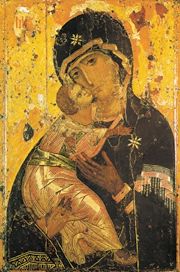
Without Corruption: A Commentary on the Hymn to the Theotokos


A Commentary on the Hymn to the Theotokos

The hymn in Greek is:
Ἄξιόν ἐστιν ὡς ἀληθῶς,
μακαρίζειν σε τὴν Θεοτόκον,
τὴν ἀειμακάριστον καὶ παναμώμητον
καὶ μητέρα τοῦ Θεοῦ ἡμῶν.
Τὴν τιμιωτέραν τῶν Χερουβεὶμ
καὶ ἐνδοξοτέραν ἀσυγκρίτως τῶν Σεραφείμ,
τὴν ἀδιαφθόρως Θεὸν Λόγον τεκοῦσαν,
τὴν ὄντως Θεοτόκον,
σὲ μεγαλύνομεν.


One translation of the hymn goes as follows:
It is truly right to bless thee, O Theotokos,
thou the ever blessed, and most pure, and the Mother of our God.
Thou the more honorable than the cherubim,
and beyond compare more glorious than the seraphim,
who without corruption gavest birth to God the Word,
thou the true Theotokos, we magnify thee.


Of the above hymn honoring the Theotokos, I have heard a question arise concerning the phrase, “who without corruption gavest birth to God the Word.” The question is over what is meant by: “without corruption.” In Greek the phrase is: τὴν ἀδιαφθόρως Θεὸν Λόγον τεκοῦσαν. The key term is τὴν ἀδιαφθόρως. But, beyond “corruption,” “stain,” or defilement,” what does this term mean to say? In short, it means that in some sense Mary herself was not corrupt in giving birth to the God the Word. Yet this doesn't answer the question of in what sense she was ἀδιαφθόρως.

For example, to illustrate the question, if I receive the word of one person and then deliver it to another, and if my memory is incorrupt, then I deliver this word without corruption. If I am without corruption in delivering the message, then what is precisely not corrupted is the message, not me. In other words, I am not the primary referent, whereas the purity of the message is. Praising the purity of the message is the true praise of the deliverer of said message, and so the praise of the deliverer is in this sense indirect. In other words, I deliver the message purely and without any diminution, and so my personal purity is not what is at question (though it could be), for the whole issue is not precisely “about me,” but about the message. The lack of corruption is not, then, primarily referring to my memory, or even to my delivery, per se, but to the purity of the message delivered. It is the message which is ultimately what is delivered incorrupt. 

Now, in reference to the hymn in question, could this be the case regarding the Theotokos? Is her incorruption not, say, a reference to her act of giving birth, to the act of delivery in and of itself, or even to her own purity, per se, but to the Word’s complete entry into humanity, an entry in which He is not diminished in any way? Of course, it is affirmed that Mary is without sin, but the question as I see it is whether this particular verse of the hymn is concerned with affirming this fact of her personal purity at this particular point.

One reason the question is important is that some have said that Mary’s act of birth was not defiled by her personal sin, and that it is a reference to her being pure in herself in the act of giving birth to God the Word. Now, I believe she was sinless in giving birth to God, but I think if this hymn is made to be a reference to this her purity, in this particular way, then it could lead to some problems regarding birth, the purity of women in childbearing, etc. It could be taken to mean that giving birth in some sense could defile a person, and that in Mary’s case it happened that she was not defiled in giving birth. But now we have to answer why giving birth would involve defilement, which is absurd, and so probably not what the hymn is referring to. It could then be pushed back to a critique of holy matrimony, where the act of having children is said to be the source of some corruption, and so Mary is said to be “pure” and “incorrupt” in giving birth simply because she did not have marital relations, which then opens the door to all kinds of problems about the nature of marriage and the act of having children, but we know that Paul in Hebrews 13:4 says the marriage bed is undefiled(ἀμίαντος).

So, in what sense is the verse from the hymn under discussion referring to the Theotokos as ἀδιαφθόρως? Well, there are a couple clues. The first is the deceptively simple observation that the hymn never actually speaks of “Mary” by name. The hymn is to the Theotokos, to the “bearer of God.” The significance is found in that Theotokos is generally understood to be the result of Christological reflection, not Mariological reflection. It is not primarily a reference to Mary, but is primarily a reference to Christ via Mary. It is an affirmation that Mary fully bore God the Word, and not just a human nature. As such, the hymn to the Theotokos is a hymn praising Christ through Mary as Theotokos. It is not a hymn of praise to Mary’s personal piety and purity, per se, but to the Mystery of God’s taking on of human nature.

The second clue is that in this hymn the God-bearer is said to be “more honorable than the Cherubim, and more glorious beyond compare than the Seraphim.” Why? How can she be said to be greater than these exalted beings? Well, the following words of the hymn indicate an answer, but before looking at them it would help to first reflect on the matter. In a very simple sense, what do angels do? Among other things, angels deliver God’s Word and communicate God’s will. The Theotokos, however, did not merely speak the words of the Person of God, as angels do, nor did she merely communicate God’s will and intention to human beings, as angels also do, but was a conduit for the Person of God Himself, which is an action categorically superior to that of the angels. It is therefore not mere hyperbole that says the Theotokos is more honourable than the Cherubim and more glorious beyond compare than the Seraphim, for the statement of praise is simply one of theological fact: the Theotokos did something that angelic beings simply cannot do, and so her status relative to the angels is truly “beyond compare.” 

The reason for the comparison in the first place is that they both deliver God’s Word, but the Theotokos delivers without any diminution, for she delivers the entire Person of the Word God. This, I believe, is what is actually meant by ἀδιαφθόρως. Her delivery of God into humanity is truly without any corruption, and the taking on of flesh in no way diminishes the completeness and the fullness of God’s presence in human form, the form borne by the Theotokos. This, then, resolves the problem of trying to see Mary’s personal purity as being what is at stake in the hymn. It is not a reference to the act itself of giving birth, nor to the act of the marital conception of children, but to the utter fullness of God who took flesh through her. 

The absence of corruption in the Theotokos is thus following upon the statement honouring and glorifying her beyond the angels, for their delivery of God’s word is necessarily partial whereas the Theotokos’ is anything but partial. She received the whole Person, and she gave birth to the whole Person. In other words, the giving of God flesh did not reduce Him in any way. Not then a reference to her exalted personal purity, the sense, therefore, in which she is  said by the hymn to be “incorrupt” in giving birth to God the Word is made clear: She gave birth to nothing less than the whole Person of God the Word. And so the phrase can be read: “More honorable than the cherubim, and more glorious beyond compare than the seraphim, [for] without corruption you gave birth to [the whole Person of] God the Word [in the flesh]. True Theotokos we magnify you!”

Saturday, July 26, 2014

What is Freedom?

Many in our culture stand today behind the banner upon which is written: FREEDOM!

What, however, is freedom? What is "freedom" that people advocate for it?

One of the major assumptions today is that freedom, to be free, means that one has unrestrained access to the fulfillment of desire. In other words, it is freedom to do whatever one wants, whenever one wants to, however one wants to do it, and with whomsoever one wants to do it with. In short, freedom is the unrestricted access to express or act upon some feeling or desire.

There is a basic problem with this, however, for desire is actually a form of enslavement. Desires actually arise in the mind in an impersonal manner. One sees "object x," for example, and one finds oneself desiring it almost automatically. One sees "behavior y," and one finds oneself desiring it almost choicelessly. Did the person "choose" to desire these? Not likely. Desire is just a movement of the psyche in response to some sensory stimulus, either present or absent, real or imagined.

Now, since the act or experience of desiring just kind of "happens," when one defines freedom as the ability to act on desire, one is actually defining a form of slavery. How? Because they did not "freely" choose the desire. The desire was pre-loaded, in a manner of speaking, and so the person is seeking not to be free, but to obey! The person wants to OBEY the desire. The freedom most people seek is the freedom to obey irrational impulse, and yet they use a catchword, a slogan word, "freedom," in order to make the slavery to desire sound enlightened.

Paul, in Romans chapter 6, puts it this way: "Do you not know that to whom you present yourselves slaves to obey, you are that one's slaves whom you obey, whether of sin leading to death, or of obedience leading to righteousness?"

In other words, when one seeks to "freely" obey desire, they become desire's slave. Desire, however, has within it the seeds of misery and death. Since desire is by nature fleeting and capricious, it contains within itself its own frustration, which in turn leads to more desire, and so more enslavement, and finally spiritual death.

True freedom, however, is freedom from the tyranny of the passions, freedom from desire.

Paul continues: "For just as you presented your members as slaves of uncleanness, and of lawlessness leading to more lawlessness, so now present your members as slaves of righteousness for holiness."

This might shock some people, if they are paying close attention, for Paul is not advocating for "freedom" here at all, but for slavery, for servitude. In truth, one is either a slave of sin unto death or a slave of righteousness unto holiness and everlasting life. There is no enlightened "freedom" standing in the middle.

The Scriptures teach that true freedom is freedom from sin, not freedom to sin. True freedom is obedience to righteousness, which is unto holiness and life everlasting. Read Romans chapter 6 closely.

To close, as people cry out for "freedom," please understand that their understanding of freedom is false and depraved. It is freedom to be enslaved to sin, and to be free of righteousness, not free in any positive or life-giving sense of the word. Quite the opposite, really.